One of the first questions businesses ask after investing in AI SEO is simple:
“How long will it take before we actually see results?”
The answer is not as simple.
AI can analyze thousands of keywords, identify content gaps, optimize pages, uncover internal linking opportunities, and detect technical issues within hours. But that does not mean search engines will reward those changes immediately.
AI SEO may accelerate the optimization process, but search visibility still depends on factors such as website authority, competition, content quality, technical health, indexing, backlinks, and how consistently the strategy is implemented.
For some websites, early improvements may appear within a few weeks. For others, meaningful organic growth may take several months.
Understanding this timeline is important because AI SEO should be viewed as a long-term growth strategy rather than a quick ranking shortcut.
So, how long does AI SEO really take to work? And what determines whether results appear in weeks or months?
Let’s break it down.
What Does “Results” Actually Mean in AI SEO?
Before discussing timelines, businesses need to define what they mean by results.
SEO success is not limited to reaching the first position on Google.
AI SEO can influence several performance indicators, including:
- Search impressions
- Keyword rankings
- Organic traffic
- Website visibility
- Indexed pages
- Click-through rates
- Engagement
- Qualified leads
- Conversions
- Brand mentions
- Visibility in AI-assisted search environments
These improvements do not always happen at the same time.
For example, a newly optimized page may begin receiving more impressions before it moves significantly higher in rankings.
Similarly, a website may start ranking for dozens of additional long-tail searches before its primary commercial keyword reaches page one.
This is why AI SEO performance should be evaluated as a progression rather than a single milestone.
How Long Does AI SEO Usually Take?
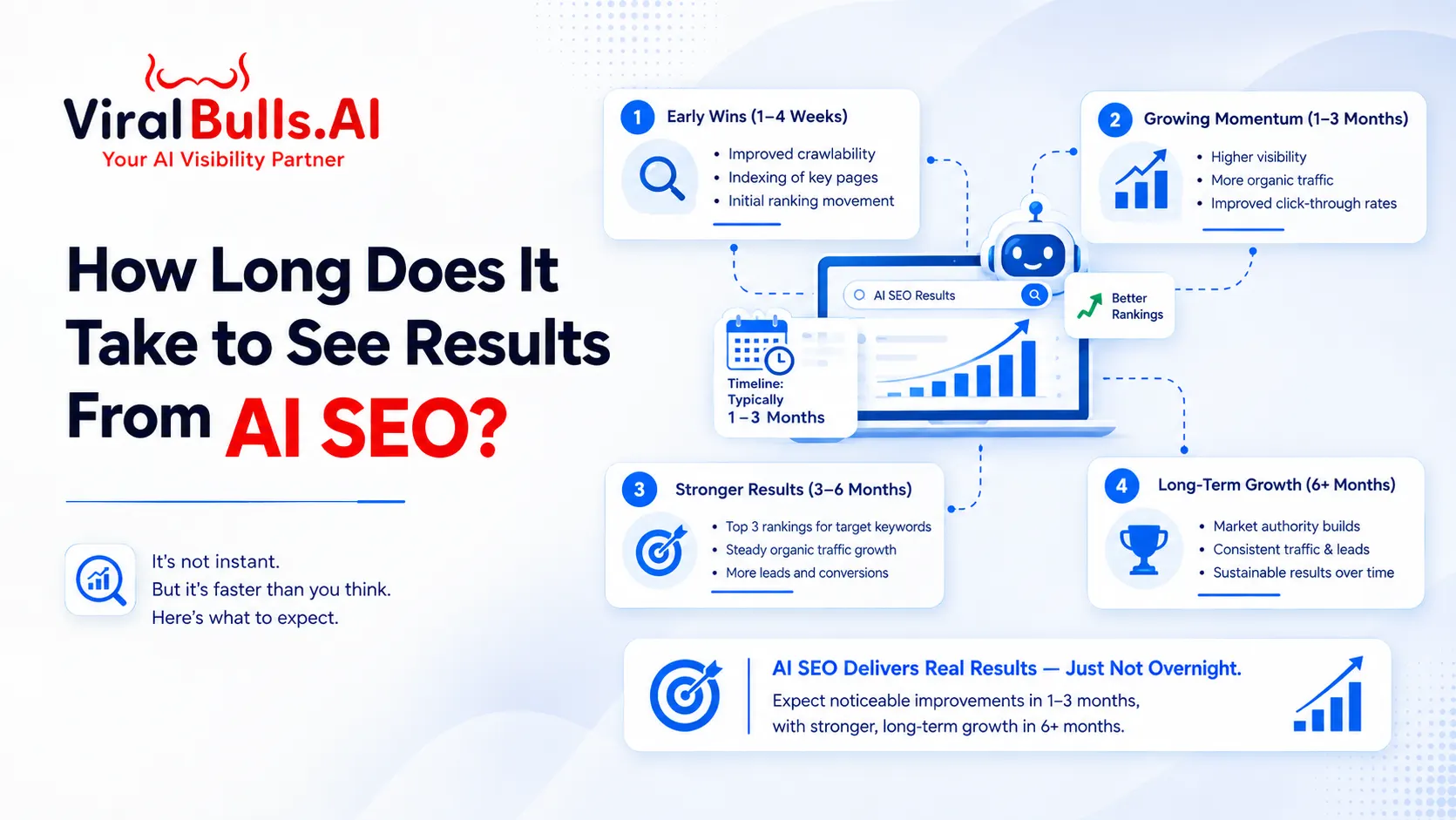
For many websites, meaningful AI SEO progress can begin appearing within approximately 3 to 6 months, although some improvements can be detected earlier.
A simplified timeline might look like this:
First 2 to 4 Weeks: Research and Foundation
During the initial stage, the focus is usually on understanding the website and identifying opportunities.
AI-powered analysis can help uncover:
- Technical SEO issues
- Content gaps
- Keyword opportunities
- Search intent mismatches
- Internal linking weaknesses
- Competitor strategies
- Underperforming pages
- Topical authority gaps
This stage may not create major traffic growth immediately, but it builds the foundation for future results.
Month 1 to Month 2: Early Search Signals
Once optimization changes are implemented, search engines need time to crawl, process, and reassess the affected pages.
During this period, businesses may begin noticing:
- Higher impressions
- More indexed pages
- New long-tail keyword rankings
- Improved positions for low-competition queries
- Better internal page discovery
- Increased crawling activity
- Small organic traffic improvements
These early movements indicate that the strategy is beginning to influence search visibility.
However, businesses should avoid evaluating the entire campaign based solely on results from the first few weeks.
Month 3 to Month 4: Measurable Growth
This is often where AI SEO begins producing clearer performance trends.
If technical improvements, content optimization, and authority-building efforts have been implemented consistently, businesses may see:
- Stronger ranking improvements
- More organic traffic
- Better keyword coverage
- Growing topical visibility
- Increased impressions
- More engagement with optimized pages
- Better performance from updated content
Content clusters can also begin strengthening each other.
For example, if a company publishes one main service page supported by several related educational articles, internal linking and topical relevance can gradually improve the authority of the complete subject area.
Month 4 to Month 6: Stronger Organic Momentum
By this stage, businesses with a solid strategy may begin seeing more substantial changes.
These could include:
- Page-one keyword movement
- Higher organic traffic
- Increased qualified enquiries
- Better-performing service pages
- Stronger visibility across multiple related searches
- Greater brand authority within specific topics
AI SEO becomes particularly valuable during this stage because data from the first few months can be analyzed to determine what is working.
Rather than continuing with the same strategy blindly, AI-assisted analysis can identify which pages deserve additional optimization.
6 Months and Beyond: Compounding SEO Growth
SEO becomes more powerful when improvements accumulate over time.
A website that consistently publishes valuable content, earns authority, improves technical performance, and updates existing pages can gradually develop a stronger competitive position.
After six months, AI can help teams continuously identify:
- Declining pages
- Emerging keywords
- New customer questions
- Competitor content gaps
- Internal linking opportunities
- Pages close to ranking on page one
- Content requiring updates
Instead of treating SEO as a one-time project, businesses can build an ongoing optimization system.
Why AI SEO Does Not Produce Instant Rankings
AI can perform tasks quickly.
Search engines do not necessarily respond at the same speed.
There are several reasons rankings may take time.
1. Search Engines Need to Re-Crawl Your Website
Updating a page does not immediately change its position.
Search engines first need to discover the modification, crawl the page again, process its content, and reconsider how relevant it is to different searches.
The frequency of crawling can vary depending on the website.
Established websites that publish frequently may be revisited more often than smaller or relatively new websites.
2. Website Authority Takes Time to Build
AI can improve content structure and identify link-building opportunities, but authority is not created instantly.
Search engines consider multiple trust and quality signals.
A website with strong industry recognition and authoritative backlinks may see faster improvements than a new domain with very little history.
3. Competitors Are Optimizing Too
SEO is not performed in isolation.
If ten businesses are competing for the same valuable keyword, improving your website does not automatically place it above them.
You need to provide a better overall search experience than competing pages.
AI can help analyze those competitors and reveal opportunities, but strong execution still matters.
What Factors Affect the AI SEO Timeline?
There is no universal SEO timeline because every website begins from a different position.
Several factors determine how quickly results may appear.
1. Age and Authority of the Website
Established websites often have an advantage.
If a domain already has:
- Strong backlinks
- Existing rankings
- Regular organic traffic
- High-quality content
- Good technical performance
then optimizations may generate results relatively quickly.
New websites often need longer because they must establish relevance and authority from the beginning.
2. Keyword Competition
Not every keyword is equally difficult.
Consider these two examples:
“marketing agency”
and
“AI marketing services for SaaS companies in Noida.”
The second search is more specific and may have lower competition.
AI SEO can help identify such long-tail opportunities where businesses may gain visibility faster while gradually building authority for more competitive keywords.
3. Technical Website Health
Technical SEO problems can significantly slow down growth.
Common issues include:
- Slow page speed
- Broken internal links
- Duplicate pages
- Poor mobile usability
- Indexing problems
- Crawl errors
- Incorrect canonical tags
- Weak website architecture
If search engines struggle to access or understand the website, even high-quality content may perform poorly.
Therefore, technical SEO should usually be addressed early in an AI SEO campaign.
4. Quality of Existing Content
A website with strong existing content may require optimization rather than complete rebuilding.
AI tools can identify pages that are already ranking between positions 5 and 20 and recommend improvements.
These pages can sometimes produce faster gains than completely new content.
A website with thin, outdated, or poorly structured content may require significantly more work.
5. Content Publishing Frequency
Consistent publishing can strengthen topical depth.
However, quantity should not become the primary objective.
Publishing 50 weak AI-generated articles is unlikely to be more valuable than publishing 10 genuinely helpful resources.
Quality, relevance, expertise, and usefulness should remain priorities.
6. Backlink Profile
Strong backlinks can help search engines recognize a website as authoritative.
AI can support backlink research by identifying:
- Relevant publications
- Competitor backlinks
- Broken-link opportunities
- Unlinked brand mentions
- Potential digital PR topics
However, reputable backlinks generally require real outreach, relationships, useful content, or newsworthy information.
Can AI SEO Produce Faster Results Than Traditional SEO?
Potentially, yes.
But not because AI has a special ability to force rankings.
AI can make the SEO workflow faster and more efficient.
For example, traditional SEO teams may spend hours manually reviewing hundreds of keywords.
AI can help group those keywords into search-intent clusters much faster.
Similarly, AI can accelerate:
- Competitor analysis
- Content gap discovery
- Content auditing
- Internal linking analysis
- SERP pattern analysis
- Keyword clustering
- Technical issue prioritization
- Content refresh recommendations
This means teams can move from analysis to implementation faster.
And faster implementation can potentially lead to earlier results.
Example: Traditional SEO Timeline vs AI-Assisted SEO
Imagine a business website has 300 existing pages.
Only 80 pages currently receive meaningful organic traffic.
Traditional SEO Approach
An SEO team manually audits each section of the website.
They review keyword rankings, competitors, internal links, and content performance.
Because of the scale of the website, prioritizing pages may take considerable time.
AI SEO Approach
AI-assisted analysis identifies:
- 25 pages ranking between positions 8 and 20
- 15 articles losing traffic
- 30 pages with weak internal linking
- 12 high-value content gaps
- Several overlapping pages targeting similar intent
The SEO team can immediately prioritize these opportunities.
Instead of spending weeks determining what needs attention, more time can be spent actually improving the website.
That is where AI SEO can significantly improve efficiency.
How to Get Faster Results From AI SEO
Businesses cannot guarantee instant SEO rankings, but they can improve the likelihood of seeing results sooner.
Start With Pages That Already Have Potential
Do not always begin by creating new articles.
Look for pages already ranking on pages two or three of search results.
Improving these pages may deliver faster results because search engines already recognize their relevance.
Fix Technical Issues Early
Technical problems can limit every other SEO effort.
Before scaling content, resolve significant crawlability, indexing, site speed, and website architecture issues.
Target Long-Tail Search Queries
Highly competitive keywords may take longer.
Specific search queries can provide earlier opportunities.
For example, instead of targeting only:
“AI marketing agency”
a business could also target:
- AI marketing agency for startups
- AI SEO services for businesses
- AI marketing services in Noida
- AI search visibility agency
- AI-powered SEO company
These queries may also reflect stronger commercial intent.
Build Topic Clusters
One article rarely establishes deep subject authority.
Create groups of related content.
For example:
Main Topic:
AI SEO
Supporting Topics:
- What is AI SEO?
- AI SEO vs traditional SEO
- How long does AI SEO take?
- What does AI SEO cost?
- How does AI SEO work?
- AI SEO benefits
- AI SEO tools
- AI search visibility
- Generative engine optimization
These interconnected pages can strengthen the site’s topical structure.
Update Existing Content
Older articles may already have backlinks, indexing history, and search visibility.
AI can identify outdated information, missing sections, weak search intent alignment, and related questions that should be added.
Refreshing these pages may sometimes provide faster gains than publishing entirely new content.
Combine AI With Human Expertise
AI should support SEO professionals rather than operate without supervision.
Human experts are still needed for:
- Strategy
- Brand positioning
- Content quality
- Fact-checking
- Audience understanding
- Conversion optimization
- Original insights
- Editorial judgment
The strongest AI SEO workflow combines machine intelligence with human decision-making.
What Should Businesses Measure During the First Six Months?
Looking only at traffic can create an incomplete picture.
Businesses should monitor leading and lagging indicators.
Early Indicators
During the first few months, monitor:
- Crawl activity
- Indexed pages
- Search impressions
- Number of ranking keywords
- Average search positions
- Long-tail visibility
Growth Indicators
As the campaign develops, monitor:
- Organic sessions
- Page-one rankings
- Click-through rate
- Engagement
- Leads
- Calls
- Form submissions
- Revenue from organic search
SEO should ultimately contribute to business outcomes, not simply ranking reports.
Common Mistakes That Slow Down AI SEO Results
Even powerful AI technology cannot compensate for a poor SEO strategy.
Avoid these common mistakes.
Publishing Large Amounts of Generic AI Content
More content does not automatically produce more traffic.
Every page should have a clear purpose.
Ignoring Search Intent
Ranking for a keyword requires understanding what the searcher actually wants.
Neglecting Technical SEO
Content cannot perform effectively if search engines struggle to crawl or index it.
Expecting Results After Two Weeks
SEO requires patience.
Short-term fluctuations should not determine long-term strategy.
Never Updating Content
Search behavior changes.
Competitors improve.
Content should therefore be reviewed and refreshed regularly.
How Businesses Should Approach AI SEO
A practical AI SEO strategy should operate in phases.
Phase 1: Diagnose
Audit technical performance, existing rankings, competitors, content, backlinks, and search opportunities.
Phase 2: Prioritize
Use data to identify the opportunities with the highest potential impact.
Phase 3: Optimize
Improve existing pages, technical SEO, content structure, internal links, and search intent alignment.
Phase 4: Expand
Build new content around relevant topics and customer questions.
Phase 5: Measure and Improve
Continuously analyze performance and update the strategy based on results.
This creates an SEO system rather than a collection of isolated optimization tasks.
So, How Long Should You Give AI SEO?
Businesses should generally think in terms of months rather than days.
Minor improvements may emerge within the first few weeks.
More meaningful progress often develops over approximately three to six months.
Highly competitive campaigns may require longer.
The timeline depends on where the website starts, how competitive the market is, how quickly recommendations are implemented, and how consistently the strategy is maintained.
AI can dramatically speed up research, analysis, prioritization, and optimization.
What it cannot do is bypass the fundamentals of organic search.
Final Thoughts
AI SEO is not an overnight ranking solution.
Its real advantage is that it allows businesses to make SEO decisions faster, analyze more data, identify opportunities earlier, and optimize websites more systematically.
Traditional SEO might require teams to manually search for performance gaps.
AI can surface those opportunities faster.
But rankings, authority, trust, and organic traffic still need time to develop.
The businesses most likely to succeed are therefore those that combine patience with faster execution.
Use AI to accelerate analysis.
Use experienced marketers to guide strategy.
Build strong technical foundations.
Publish useful content.
Strengthen authority.
Measure performance continuously.
At Viralbulls AI, the goal is not simply to use artificial intelligence because it is the latest marketing technology. It is to apply AI strategically to improve how brands are discovered, understood, and positioned across modern search environments.
Because successful AI SEO is not about getting results overnight.
It is about building a smarter search strategy that produces stronger results over time.