Ranking Is No Longer the Final Win
Your website ranks on the first page of Google.
Your SEO report looks healthy. Traffic is coming in. Your priority keywords are moving in the right direction.
Then someone asks ChatGPT, Gemini, Perplexity, or another AI-powered search experience for the best companies in your category, and your brand is nowhere in the answer.
That gap is becoming one of the biggest visibility problems for modern businesses.
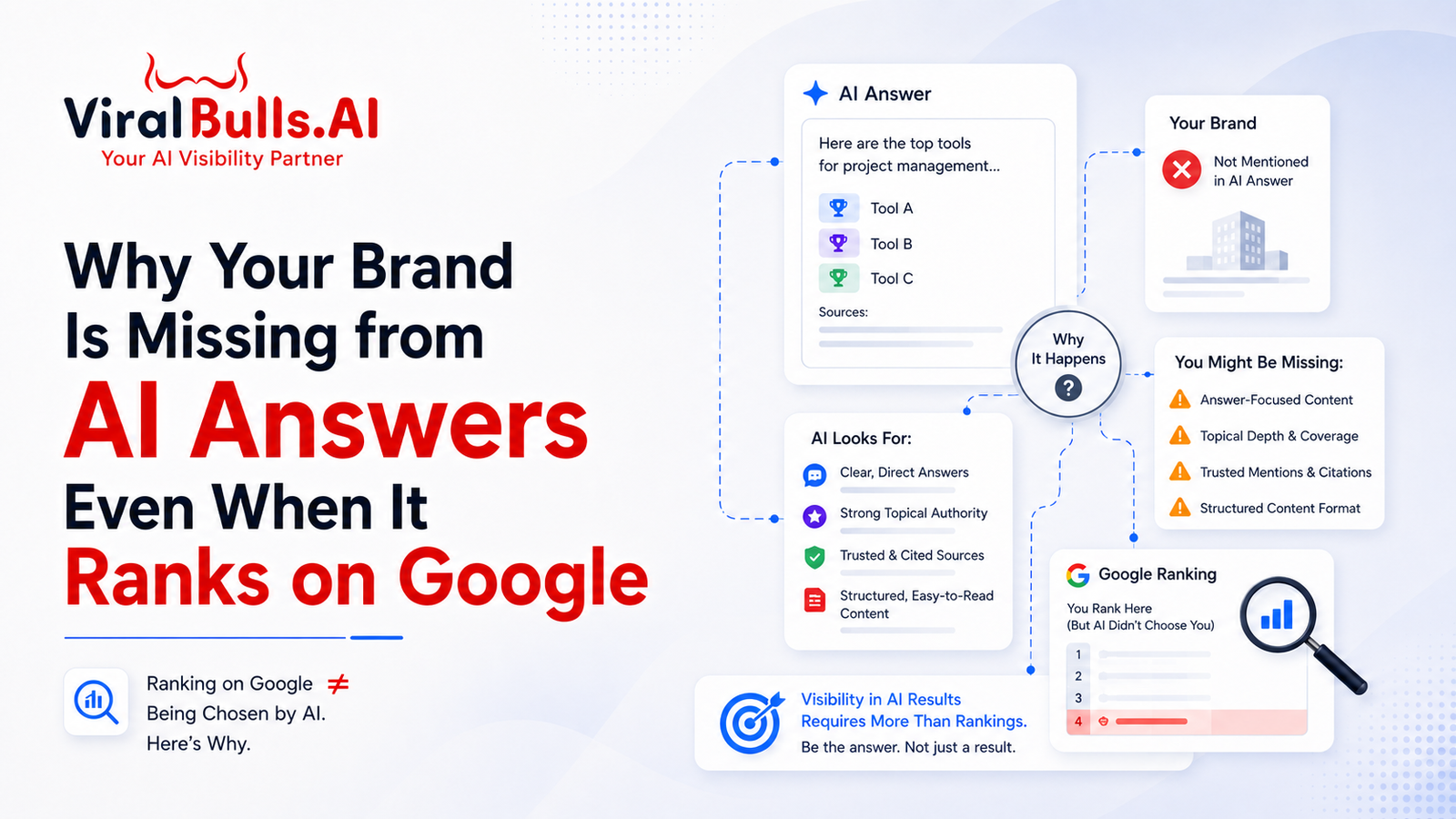
Search is no longer only about earning a position on a results page. It is also about becoming a source that AI systems can understand, trust, cite, and recommend. A brand can perform well in traditional search and still remain invisible in AI-generated answers.
So why does this happen, and what can businesses do about it? Let us break it down.
The Search Journey Has Changed
Traditional search gives users a list of pages to compare.
AI search compresses that journey into a synthesized answer that may include only a few named brands or cited sources. Businesses are now competing to become part of the answer itself.
This does not make SEO irrelevant. SEO fundamentals such as crawlability, helpful content, and clear structure still support visibility. But they may not create enough context or authority for an AI system to confidently mention your brand.
Ranking on Google and Appearing in AI Answers Are Not the Same
| Area | Traditional Search Visibility | AI Answer Visibility |
| Primary goal | Rank a page for a relevant query | Become a trusted source or recommendation |
| Content signal | Keyword relevance and page quality | Complete context, clarity, and source confidence |
| Authority signal | Backlinks and domain reputation | Brand mentions, expertise, consistency, and corroboration |
| User outcome | A click to your website | An answer that may name or cite your brand |
| Optimization focus | Individual pages and search intent | Topics, entities, evidence, and answer readiness |
The systems overlap, but they do not evaluate visibility in the same way.
Why Your Brand Is Being Left Out
1. Your Content Targets Keywords but Does Not Fully Answer the Question
Many pages are built to rank for one phrase. They include the keyword, a basic definition, a service description, and a call to action.
AI systems often need content that explains the issue, clarifies differences, addresses follow-up questions, and resolves the user’s real decision.
For example, a page targeting “AI marketing agency” may rank locally, while an AI answer may favour a competitor that explains experience, process, use cases, results, and selection criteria more clearly.
2. Your Website Has Pages, but Not Topical Authority
One strong article rarely establishes authority. AI systems understand brands better when their websites consistently cover the surrounding topic.
A company offering AI SEO services should build connected content around Generative Engine Optimization, AI citations, entity optimization, answer visibility, measurement, technical SEO, and brand authority.
3. Your Brand Signals Are Weak Outside Your Website
Your website can describe your company as an expert. That does not automatically make the claim credible.
AI search encounters your brand across directories, articles, interviews, reviews, case studies, social profiles, and industry discussions. Weak or inconsistent signals reduce category confidence.
Digital PR, expert contributions, case studies, accurate profiles, and credible third-party mentions provide validation beyond your own marketing copy.
4. Your Content Is Difficult to Interpret
A visually attractive page can still be confusing to machines and users. Long introductions, vague headings, hidden answers, unsupported claims, and inconsistent terminology make it harder to understand the page’s purpose.
Clear headings, concise explanations, relevant internal links, author information, updated dates, and suitable structured data make content easier to process. Structured data can support understanding, although markup cannot compensate for weak content.
5. You Are Not Giving AI a Reason to Mention Your Brand
Generic content is easy to summarize without naming its source. If your article repeats information available on hundreds of websites, an AI answer may use the idea but have little reason to recommend your brand.
Original research, frameworks, comparisons, expert observations, proprietary data, and case studies create stronger citation value. Publish something distinctive enough to deserve attribution.
What AI Systems Need Before They Can Trust Your Brand
- Clear relevance: Your content directly answers the question being asked.
- Demonstrated expertise: Authors, examples, and experience support the advice.
- Topical depth: The website covers the subject beyond a single article.
- Consistent entities: Brand names, services, people, locations, and claims match across channels.
- Independent validation: Reviews, mentions, links, and citations support your positioning.
- Accessible content: Important pages can be crawled and understood without unnecessary barriers.
- Freshness where it matters: Time-sensitive information is reviewed and updated.
How AI SEO Services Close the Visibility Gap
AI SEO services expand the objective of search optimization. Rankings and traffic still matter, but the strategy also considers whether AI-powered search experiences can identify the brand, understand its expertise, and use its content in relevant answers.
A practical AI visibility programme starts by mapping the questions customers ask before choosing a product, service, or provider. Content is organized around complete decision journeys rather than isolated keywords.
Next, the brand’s services, leadership, industries, proof, and differentiators must be consistent across the website and credible external sources. Technical improvements clarify the pages, while authority building strengthens independent signals.
Performance must also include branded prompts, AI mentions, citations, AI referral traffic, topic coverage, and competitor visibility.
What an SEO AI Agency Should Actually Do
An SEO AI agency should connect traditional SEO, content strategy, Generative Engine Optimization, entity development, technical implementation, and digital authority.
A credible partner should be able to answer five questions:
- Which commercial questions are AI users asking in your market?
- Why are competitors being mentioned while your brand is excluded?
- Which content and entity gaps are reducing trust?
- What technical changes will improve crawlability and interpretation?
- How will AI visibility be monitored alongside rankings and leads?
Publishing more blog posts alone is not enough. AI visibility requires coordination across the digital footprint.
A Practical Roadmap for Businesses
- Audit your AI presence by testing realistic customer questions and recording which brands appear.
- Compare cited sources to identify the evidence and authority signals competitors provide.
- Build topic clusters around customer decisions, including comparisons, costs, risks, use cases, and provider selection.
- Strengthen brand entities and technical clarity across your website and credible external channels.
- Track rankings, leads, AI mentions, citations, and visibility for high-value prompts.
How We Help Brands Become Part of the Answer
At ViralBulls, we help businesses move beyond ranking reports and build visibility for the way people search now.
Our AI SEO services combine SEO, Generative Engine Optimization, content strategy, technical optimization, entity development, and digital authority. We identify why a brand is excluded and create a plan to improve rankings and AI recommendations.
As an SEO AI agency, we focus on measurable visibility. The objective is to make your brand easier to discover, understand, and trust when customers ask for solutions.
Final Thoughts: Ranking Is Valuable, but Recommendation Is the Next Advantage
A first-page Google ranking remains valuable, but it no longer guarantees that your company will appear when users ask AI for a recommendation.
AI visibility depends on relevance, authority, structure, evidence, and consistency. Businesses optimizing only for rankings risk losing influence in the fastest-changing part of search.
The brands that adapt will help shape the answer.
If your company ranks on Google but disappears from AI recommendations, the issue may not be your position. It may be the way your brand is understood.
Frequently Asked Questions
Why does my website rank on Google but not appear in AI answers? Search rankings and AI recommendations use overlapping but different signals. A page may rank while lacking the topical depth, brand evidence, structure, or validation needed for an AI mention.
What are AI SEO services? AI SEO services improve visibility across search engines and AI answers by combining SEO, GEO, entity development, structured content, authority building, and AI visibility measurement.
What does an SEO AI agency do differently from a traditional SEO agency? An SEO AI agency optimizes for rankings and AI discovery by strengthening entities, developing citation-worthy content, improving technical interpretation, and monitoring generated answers.
Does structured data guarantee that AI will mention my brand? No. Structured data can help search systems understand page information, but it does not create authority or guarantee inclusion. It works best when the underlying content is useful, accurate, accessible, and supported by credible brand signals.
Is Generative Engine Optimization replacing SEO? No. GEO builds on SEO rather than replacing it. Crawlability, useful content, technical quality, and authority remain essential. GEO expands the strategy to improve how content and brands are understood and surfaced in generated answers.
How long does it take to improve AI visibility? Timelines vary by industry, competition, existing authority, and content quality. Established brands with strong SEO foundations may see changes sooner, while newer brands usually need sustained work across content, entities, technical SEO, and external authority before visibility improves consistently.